
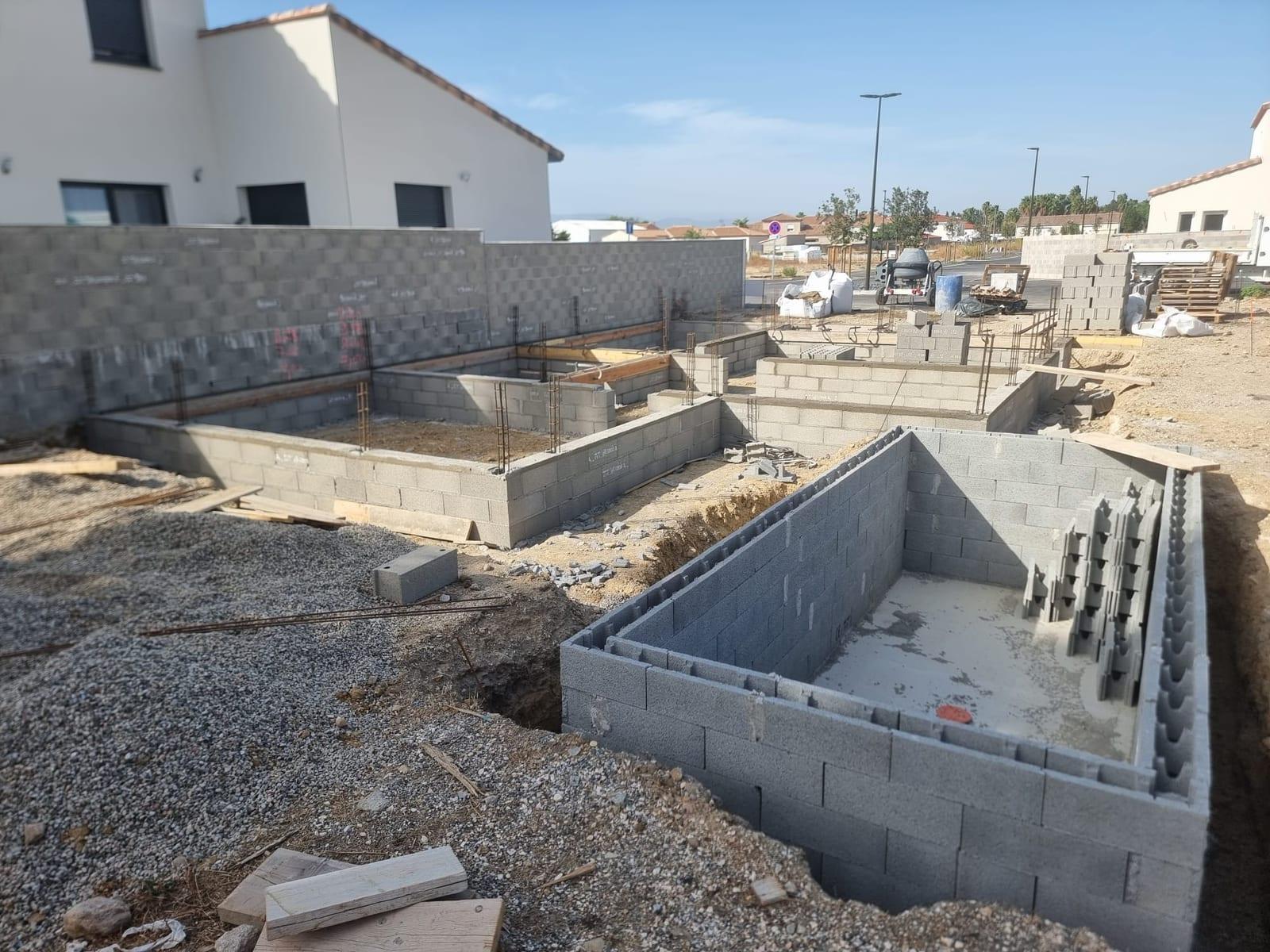
It all starts with setting out. Before the first bucketful of soil is moved, the exact position of the pool is marked on the ground: that is what will determine whether the walls are plumb and what the final geometry of the pool will be. Approximate setting out is paid for at every subsequent stage of the structural work.
Next comes the earthworks proper, with the excavation of the pool. This phase creates the volume in which the pool will be built: it is not simply a hole, but the first stage of the structure, and it governs everything that follows.
The spoil from the earthworks is lifted out and taken off site. It is an operation people often underestimate when picturing their project: excavating a pool generates a large volume of spoil, which has to be removed to free up access and let the teams work safely. The bottom of the excavation is then prepared to receive the raft slab.
The bottom of the pool is not cast straight onto the earth. Formwork goes in first: it defines the raft slab precisely, contains the concrete during the pour and guarantees clean edges, square with the original setting out.
The reinforcement is then placed inside that formwork. This is the heart of the job: in this photograph, taken before the pour, you can see the steel grid covering the whole area of the pool, along with the vertical bars projecting around the perimeter. Nothing is left to chance at this stage, because once the concrete is poured nothing can be changed.
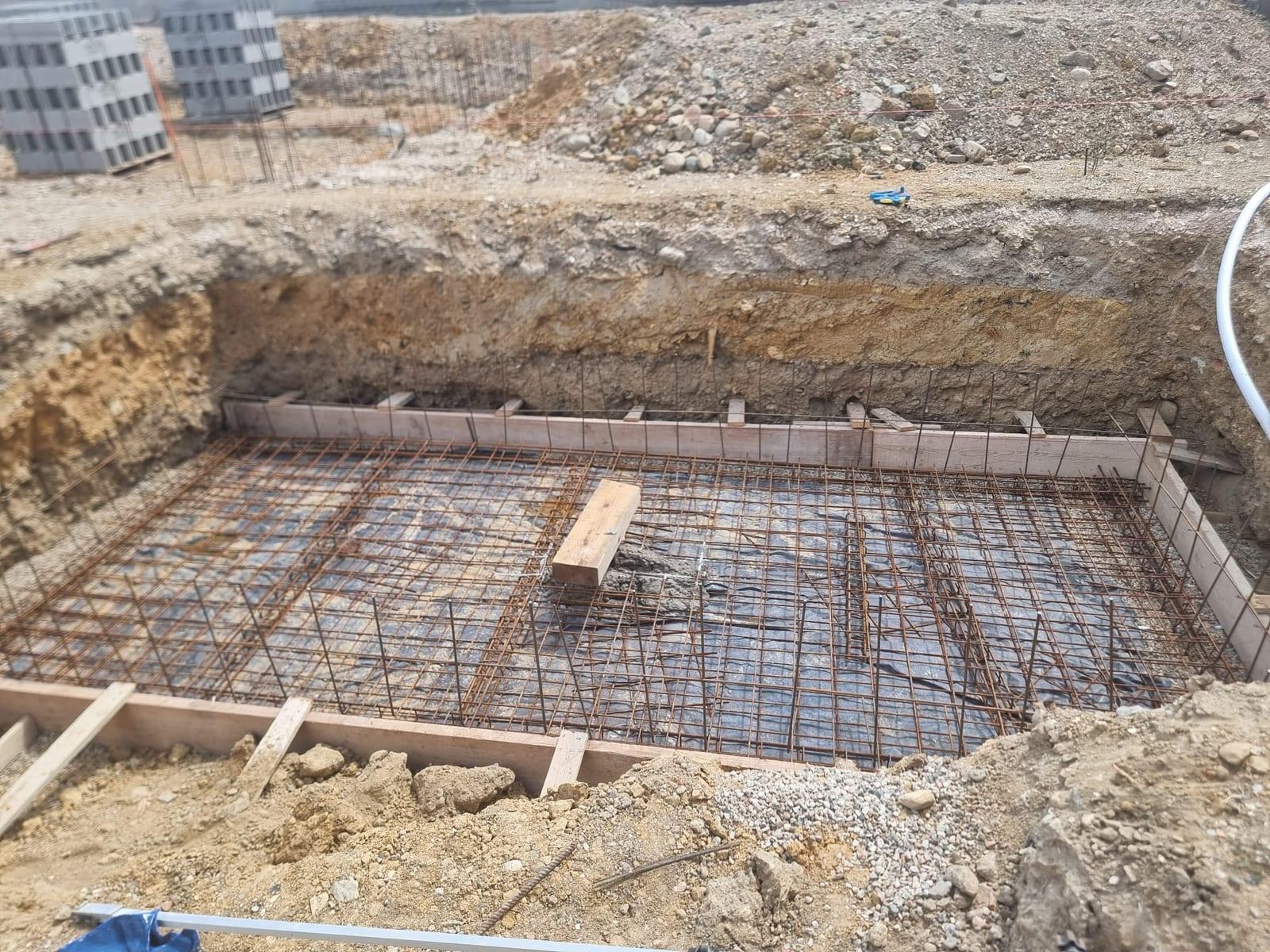
The bottom of the pool is built as a concrete raft slab around 25 cm thick. The raft slab is the load-bearing slab of the pool: it takes the loads, and the walls will bear on it.
In other words, a concrete swimming pool is not judged solely by its lining once the water is in. It is judged by what was done at this precise stage, while everything is still visible, and that is exactly the structural work we do day in, day out.
The raft slab of this pool is reinforced with a double layer of ST25 welded mesh: two layers of steel, one in the lower part of the slab and one in the upper part. Concrete performs very well in compression but poorly in tension; it is the steel that takes those forces, and placing it in two layers means working in both directions.
The vertical starter bars are also placed at this stage. These are the bars you can see projecting all round the pool in the previous photograph: they are there to tie the raft slab to the walls to come. Without them, the base and the walls would be no more than two elements simply resting one on the other.
These starter bars are positioned and tied to the reinforcement before the pour. It is an important point of method: a starter bar badly placed or badly tied moves during the pour, and you only notice when the walls go up, by which time it is too late to put right properly.
The raft slab was poured using a concrete pump. There are two benefits. First, the concrete reaches the pool without machines having to move around the edge of the excavation, which is often the only workable solution given the site access and the layout of the plot.
Second, the pump allows an even pour across the whole pool. A raft slab must be cast in one go, with no break or interruption: that is what makes the slab homogeneous.
The concrete used on this project is a waterproofed concrete. This improves how the concrete behaves in contact with water, but it does not replace the other measures and the lining planned for the pool: it is one element of the construction, not a solution that on its own would do away with everything else.
Once the raft slab was complete, the walls could go up. The pool walls are built in shuttering blocks, set out and then raised all round the pool, continuing on from the vertical starter bars left in the raft slab.
That is the stage currently visible on the Pia site: the pool is coming out of the ground and its volumes are becoming legible. The photograph at the head of this article shows the site at this point, with the walls going up and the other masonry work in progress around the pool.
The project is still under way at the time of writing. We will share the next instalment shortly, with the progress of the walls and the following stages of the pool.
When people look into building a pool, they usually start with the shape, the colour of the water and the surroundings. Yet it is the stages described here, from setting out, earthworks and reinforcement to the raft slab and the tie to the walls, that determine how sound the structure is and how well it lasts.
A concrete swimming pool is a masonry structure in its own right. That is our original trade, and it is why we carry out these projects with our own teams: the structural work of a pool calls for exactly the same skills as that of a house.