
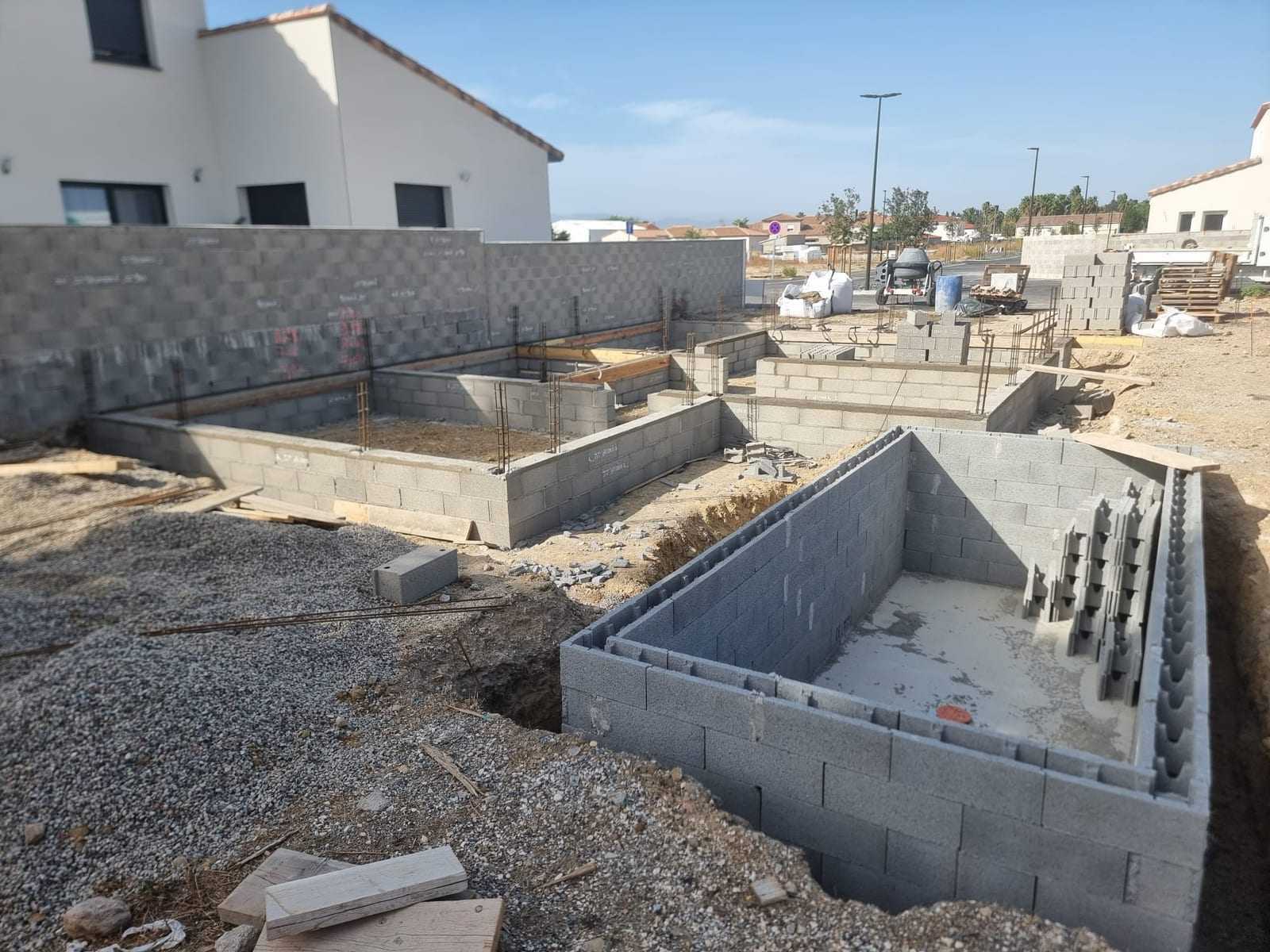
Structural work applied to a pool
A pool built on site, in reinforced concrete, by the same teams that build our houses: a bespoke structure, calculated for your ground, whose strength is decided long before it is filled with water.
Why masonry concrete
An in-ground concrete swimming pool is a piece of structural work. What holds it up, nobody will ever see: the preparation of the excavation base, the sizing of the reinforcing steel, the joint between the floor and the walls. That is exactly the trade we practise every week on our house, foundation and wall projects.
Built to measure, a masonry pool adapts to your plot — slope, access, type of ground — and to what you want: free-form shape, built-in steps, a bench seat, the depth of your choice. In the Aude, where clay soils call for rigour, the quality of the structure makes all the difference over time.
Before we even talk about shape, two points are settled at the site visit. How the digger and the concrete mixer lorry get in: an enclosed garden, a narrow gate or a house already built changes the way the project site is organised. And where the soil goes: pool earthworks take a volume of spoil out of the plot that is almost always underestimated, and it has to be carted away to free up access and let the teams work safely.
On site, step by step
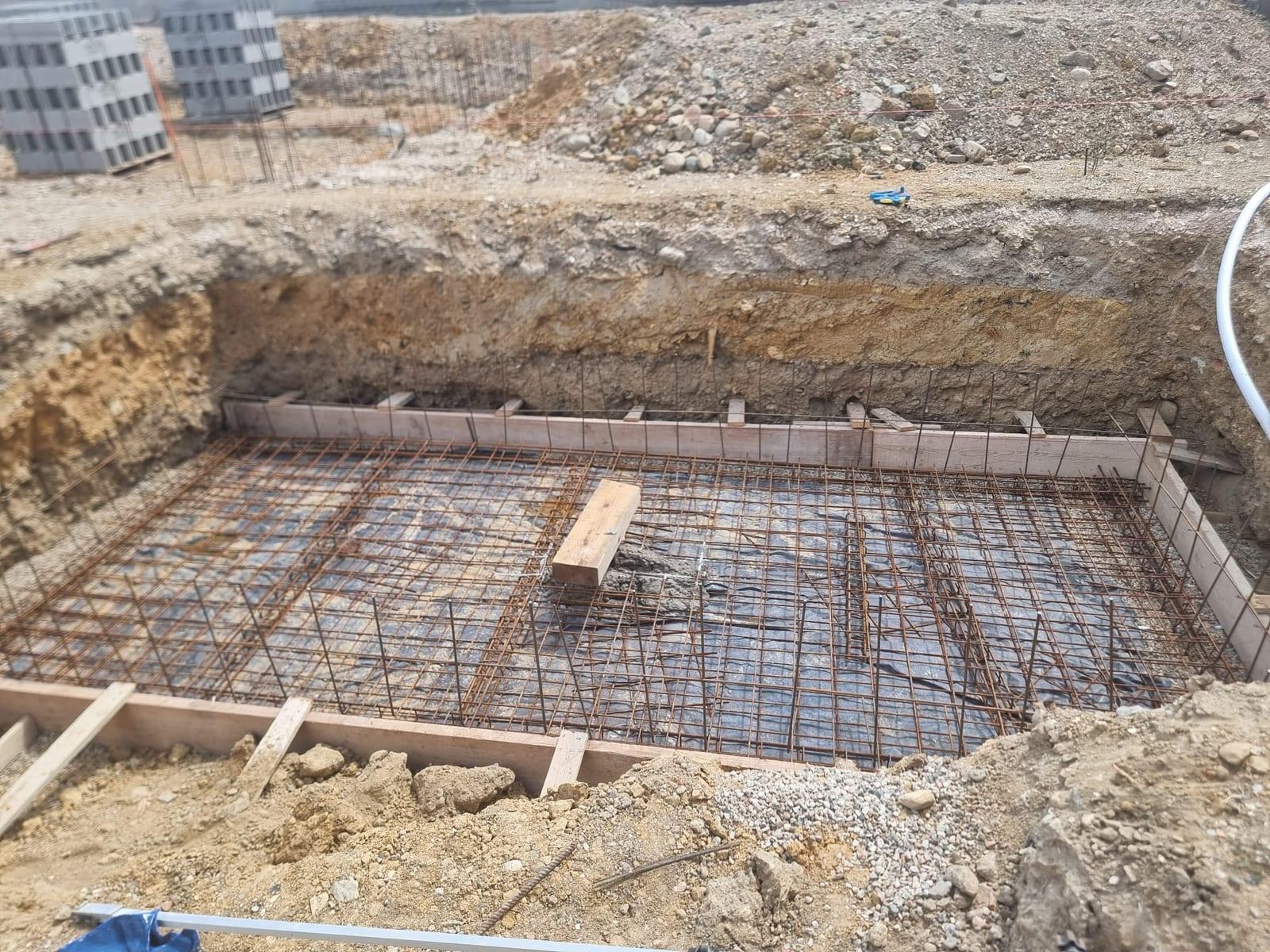
The sequence is the same whatever the pool. This one comes from our swimming pool project in Pia, where we publish the progress photo by photo.
Setting out and earthworks
The exact position of the pool is marked out on the ground before the first bucketful is dug: it is what governs the plumb of the walls and the final geometry. The excavation follows, then the soil is lifted out and taken off site.
Formwork and reinforcement of the base
The floor is never poured straight onto the ground. It is shuttered, then reinforced with two layers of welded mesh — one bottom layer, one top layer. Vertical starter bars are tied all the way round: these are what will tie the floor to the future walls.
Pouring the raft slab
The raft slab is poured in one go, with a concrete pump: no construction joints, a single homogeneous slab that takes the pressure of the water and the loads from the ground. At Pia it is around 25 cm thick, in waterproofed concrete.
Raising the poured concrete walls
The walls go up in hollow shuttering blocks, continuing on from the starter bars, reinforced vertically and horizontally and then filled with concrete. Floor and walls then form one single structure.
Around the pool
We build the full masonry structure of the pool and its surrounds — thought through together, from the very first site visit. The equipment (filtration, waterproof lining) is settled with you when the project is drawn up.
Masonry steps and bench
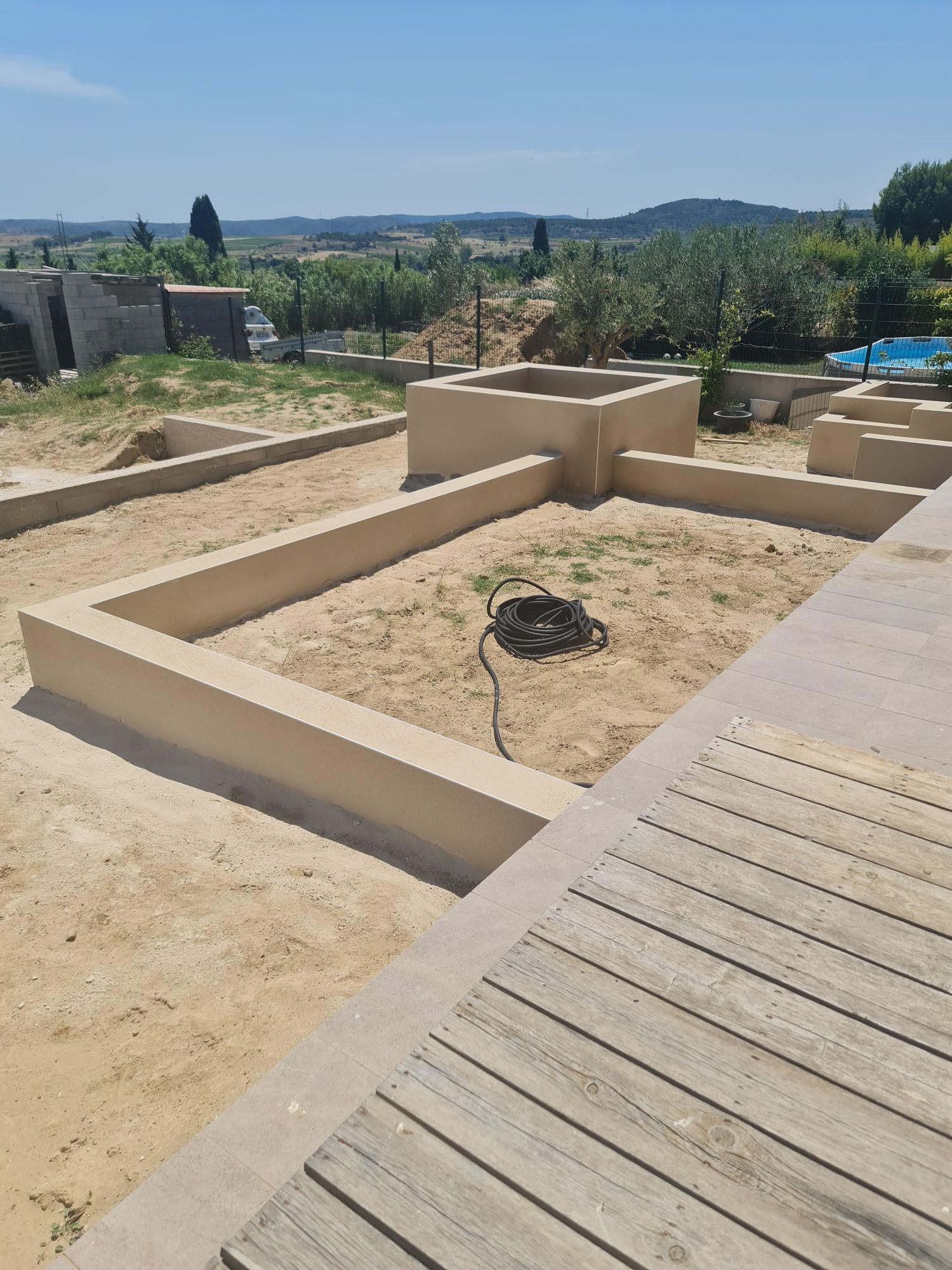
Corner steps, wide treads, submerged bench: they are built together with the pool, as part of the same structure — not added on afterwards.
Concrete pool surround and terrace
The slab that runs around the pool is poured with its falls and levels, ready to take the surface finish you have chosen.
Low walls, fencing and plant room
A low retaining wall where the ground falls away, a boundary wall around the pool, a masonry plant room: the structures that enclose and tidy the space around the swimming pool.
A pool project almost always comes with earthworks and outdoor masonry : so it makes sense to carry them out together, with the same team and a single quote.
Your protection
The buried structure of a masonry pool is structural work: it is built with the same care — and the same warranties — as our foundations and our walls.
1 year
Garantie de parfait achèvement
For the year following handover, any defects reported are put right by the company — the French one-year defects warranty.
2 years
Garantie biennale
This two-year warranty covers equipment that can be removed from the structure: taps, shutters, boiler…
10 years
Garantie décennale
For ten years it covers damage that affects the strength of the building.
In place
Assurance dommages-ouvrage
This insurance pre-finances repairs without waiting for a court decision. You are given the certificates.
FAQ
Masonry pool or moulded shell pool: what is the difference?
A shell pool is a prefabricated unit lowered into the excavation: quick, but with its shape and dimensions fixed for you. A masonry pool is built in place, in reinforced concrete: shape, dimensions, depth, steps and benches are entirely up to you, and the structure is known for its long life.
Do you need permission to build a swimming pool?
As a general rule: no formality up to 10 m² of pool (outside protected areas), a déclaration préalable (prior notification of works) from 10 to 100 m², and a permis de construire (French planning permission) above that. Local PLU rules can add further constraints — we check this point with you before the first bucket of earth, as we do for all our work.
Which safety device is compulsory around the pool?
A private in-ground swimming pool that is not enclosed must be fitted with at least one approved safety device: a protective barrier, an alarm, a cover or an enclosure. The choice is yours. We carry out the masonry side of these safety measures — low walls, boundary walls, anchors and supports — and we allow for them when positioning the pool, right from the design stage.
Do you build swimming pools outside the Aude?
Our usual area is Narbonne, the Grand Narbonne, the Corbières, the Minervois and the Aude coast, as far as the Béziers area. We do sometimes go further afield: the swimming pool project site we are following here is in Pia, in the Pyrénées-Orientales. Tell us about your project and we will tell you honestly whether we can take it on.
Free site visit: siting, access, nature of the ground — we look at what your plot really allows.